Dashboard Overview
Audience: Store owners, marketing managers, and growth teams.
The Reevix dashboard is your command centre. It gives you a real-time pulse on store performance — from conversion rates and revenue to live shopper signals and funnel health — all in one place.
The KPI Cards
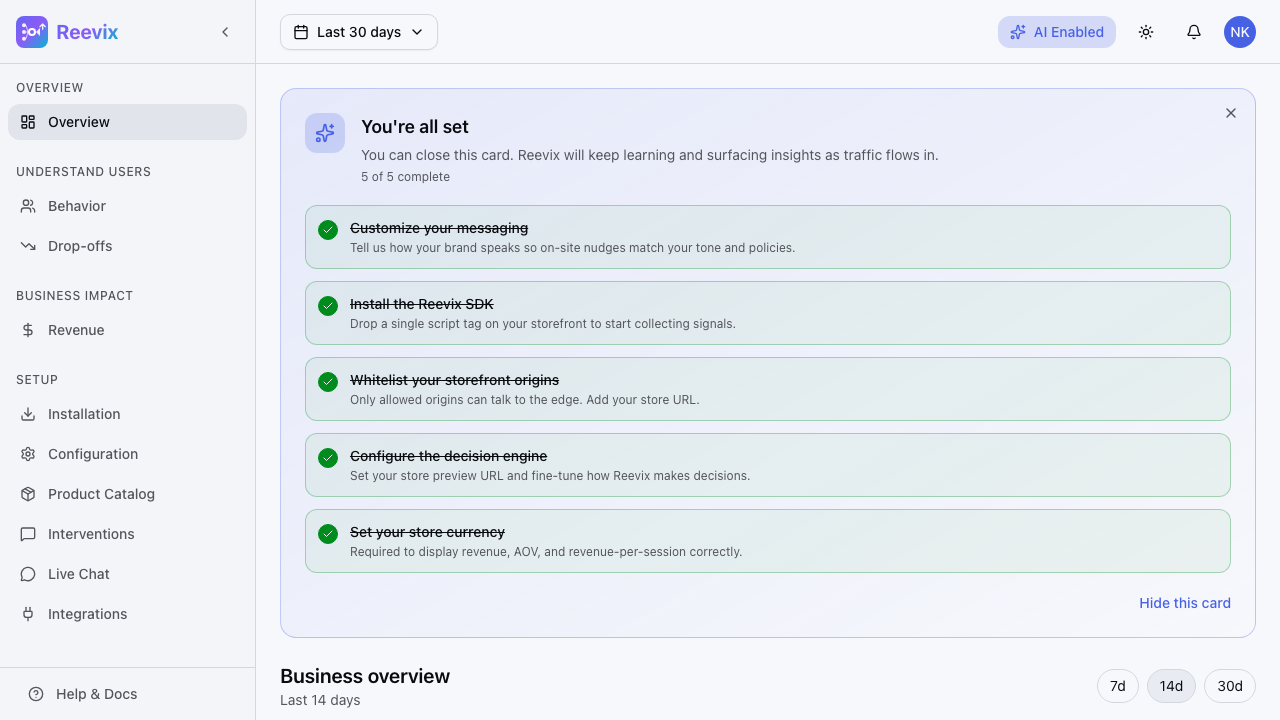
The top row shows four headline metrics for your selected time period (7, 14, or 30 days):
| Metric | What It Means | Why It Matters |
|---|---|---|
| Conversion Rate | Percentage of sessions that resulted in a purchase | Your primary health indicator |
| Revenue | Total revenue attributed to Reevix-influenced sessions | Shows direct financial impact |
| Average Order Value (AOV) | Mean spend per completed order | Tracks upsell and cross-sell effectiveness |
| Revenue Per Session | Revenue ÷ total sessions | Measures how efficiently traffic converts to money |
Each card shows the current period value alongside a trend arrow comparing it to the prior period. A green upward arrow is good; a red downward arrow signals a drop worth investigating.
Configuring the Date Range
Click the 7D / 14D / 30D pill buttons in the top-right of the dashboard to switch between time windows. Reevix recalculates all metrics instantly — no page reload.
Shopper Signals Panel
Below the KPI cards, Reevix surfaces five real-time behavioural signals collected from your shoppers:
| Signal | What It Measures |
|---|---|
| Rage Click Rate | % of sessions with 3+ rapid clicks on a non-interactive element — a frustration indicator |
| Form Friction Rate | % of sessions with repeated failed form interactions (checkout, search) |
| Exit-Intent Rate | % of sessions where the visitor showed strong exit signals before leaving |
| Deep-Scroll Rate | % of sessions where the visitor scrolled past 75% of a page — a strong interest signal |
| Avg. Dwell Time | Mean time visitors spend on product and category pages |
AI Insight Bullets
Beneath the signals panel, Reevix generates plain-language AI observations based on current signal patterns. For example:
"Exit-intent rate is elevated on product pages — consider adding a shipping reassurance message."
These bullets update daily. They are not recommendations you need to act on manually — the autopilot already acts on these patterns. They are surfaced here for context.
Conversion Funnel Widget
The dashboard also shows a mini conversion funnel summarising the four standard stages for the selected period:
| Stage | What It Counts |
|---|---|
| Page View | All sessions that landed on any store page |
| Add to Cart | Sessions where at least one product was added to cart |
| Checkout Started | Sessions that reached the checkout page |
| Purchase | Sessions that completed an order |
Each step shows the drop-off percentage to the next step. If a step has a significantly high drop-off, the widget highlights it in amber or red. Click View full funnel to jump to the Drop-offs page for a detailed breakdown.
Behavioral Intent Distribution
Below the funnel, the dashboard shows a compact intent distribution bar — a breakdown of what percentage of sessions are in each of the five behavioral states (Exploring, Comparing, Evaluating, Ready, Buying) for the selected period.
A healthy store shows a funnel shape: many Exploring, fewer Comparing and Evaluating, and fewer still in Ready and Buying. If your distribution is flat — large Exploring, almost no Ready — your product pages may not be doing enough to advance shopper intent.
See the Shopper Behavior page for the full trend view and per-state analysis.
Reading the Dashboard — A Practical Walk-Through
Scenario: Conversion rate dropped 2% this week.
- Check the Exit-Intent Rate signal — if it spiked, shoppers may be leaving due to price or trust concerns
- Check Form Friction Rate — a spike suggests checkout issues (e.g., payment form errors)
- Look at the funnel widget — which step has the biggest drop-off compared to last period?
- Jump to Drop-offs to see the full funnel breakdown with severity ratings
- Check Revenue to confirm whether revenue dropped proportionally (if revenue held steady while CVR fell, AOV likely rose)
Multi-Store Switching
If your account manages multiple stores (e.g., a UK store and a US store), use the store selector in the top navigation bar to switch context. All dashboard metrics immediately update to show data for the selected store.
Tip: Bookmark the dashboard URL for your primary store — Reevix persists your store selection across sessions.